> For the complete documentation index, see [llms.txt](https://docs.screendesk.io/llms.txt). Markdown versions of documentation pages are available by appending `.md` to page URLs; this page is available as [Markdown](https://docs.screendesk.io/security/hide-sensitive-data.md).
# Hide sensitive data
Automatically blur sensitive UI elements in your app during recordings.
Screendesk can automatically blur sensitive areas of your web application during recordings. The blur effect covers only the elements you specify using CSS selectors, so the rest of the application remains fully visible. This lets support agents record and review sessions without exposing passwords, credit card numbers, personal identifiers, or other confidential data.
{% hint style="info" %}
**Plan Availability:** Pro and Enterprise only
{% endhint %}
***
### How It Works
When blur is enabled, Screendesk applies a visual overlay to the HTML elements that match your configured CSS selectors. The effect uses the element's own text color to fill it completely, making the content unreadable while preserving the layout and shape of the page.
The blur is applied in real time when a recording session starts. The Screendesk snippet installed on your web application communicates with the recorder over WebSockets, and the blur state is synchronized across all open tabs of the same browser session using localStorage events.
Agents can toggle the blur on and off during a recording using the eye icon in the recorder interface. When the recording session ends or the recorder page is closed, the blur is automatically removed.
***
### Prerequisites
Before you can use the blur feature, the **Screendesk embed snippet** must be installed on your web application. This is the same snippet used by the Console Logs feature — if you have already installed it for console logs, you do not need to add it again.
{% hint style="info" %}
The embed snippet is a small JavaScript tag that loads the Screendesk widget on your pages. Without it, Screendesk cannot communicate with your web application to apply or remove the blur.
{% endhint %}
***
### Setting Up Blur
{% stepper %}
{% step %}
#### Go to Web App Blur settings
Navigate to **Account Settings → Web App Blur** (listed under the Security section in the sidebar).
{% endstep %}
{% step %}
#### Enable the toggle
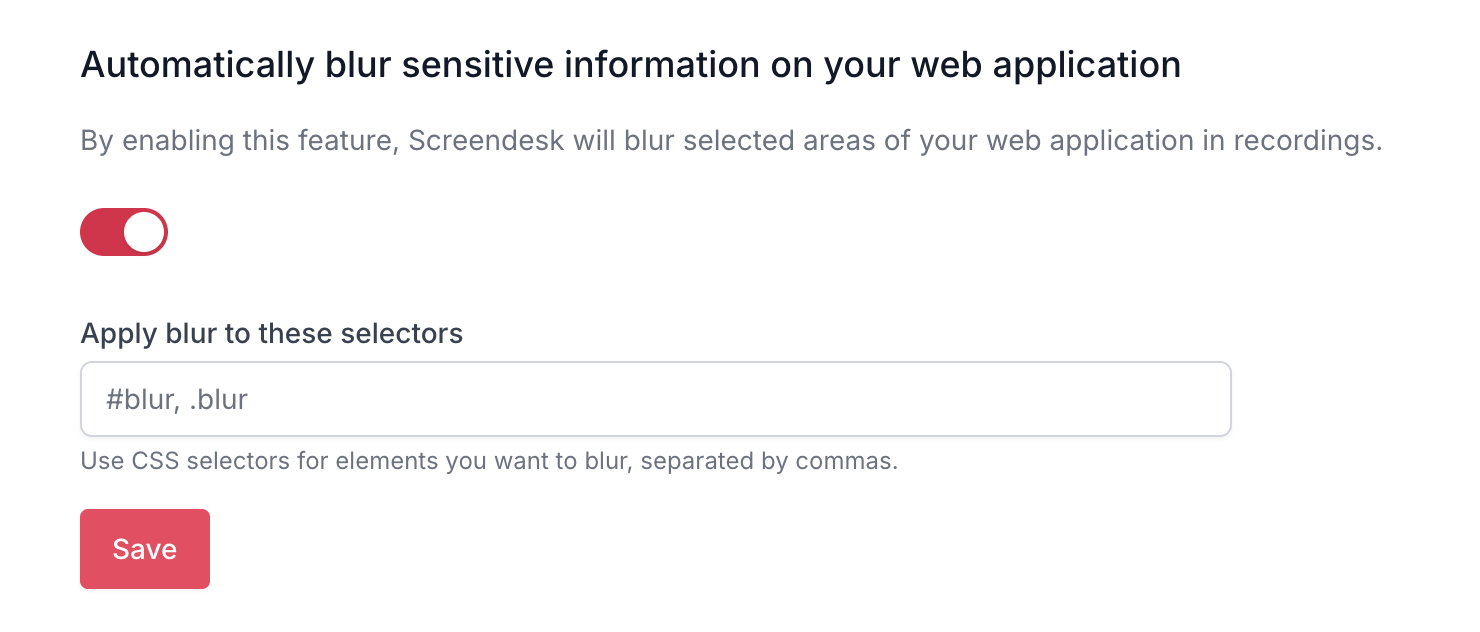
Switch on the blur toggle at the top of the page. This activates the feature for your workspace.
{% endstep %}
{% step %}
#### Add CSS selectors
In the **Apply blur to these selectors** field, enter the CSS selectors for the elements you want to blur, separated by commas.
For example:
```
#account-number, .credit-card, .ssn-field
```
These follow standard CSS selector syntax — the same format used by the browser's `querySelector()` API.
{% hint style="warning" %}
You must add at least one selector for the blur feature to activate. The toggle alone is not enough — both the toggle and at least one selector are required.
{% endhint %}
{% endstep %}
{% step %}
#### Save
Click **Save** to apply your settings.
{% endstep %}
{% step %}
#### Install the embed snippet
If you haven't already installed the Screendesk snippet, copy the code shown in **Step 1** on the settings page and add it before the closing `` tag on every page of your web application where you want blurring to work.
You can also click **Email instructions** to send the snippet to a developer on your team.
{% hint style="info" %}
Do not add the snippet twice. If you have already installed it for the Console Logs feature, it will also handle blurring — no additional installation is needed.
{% endhint %}
{% endstep %}
{% step %}
#### Verify the installation
Click the **Verify** button in **Step 2** on the settings page. Paste a URL from your site into the dialog and click **Check setup**. Screendesk will check that the embed snippet is present on that page.
{% endstep %}
{% endstepper %}
***
### Choosing CSS Selectors
To blur the right content, you need to identify the CSS selectors for the sensitive elements in your web application.
**How to find a selector:**
1. In your browser, right-click the element that contains sensitive data.
2. Select **Inspect** to open the developer tools.
3. Look at the highlighted HTML element and note its class name or ID.
**Selector syntax:**
| Selector type | Syntax | Example |
| ------------- | -------------------- | ------------------------ |
| Class name | Prefix with a dot | `.credit-card-number` |
| ID | Prefix with a hash | `#ssn-field` |
| Tag name | Use the tag directly | `input[type="password"]` |
Enter multiple selectors separated by commas:
```
.account-balance, #routing-number, .pii-field
```
{% hint style="info" %}
If your application already marks sensitive fields with a specific CSS class (for example, `.sensitive` or `.pii`), you can use that class directly as your selector. This is the simplest approach and avoids having to list every field individually.
{% endhint %}
***
### Using Blur During a Recording
When blur is enabled and at least one selector is configured, the recorder interface displays an eye icon in the top-right corner.
**Default behavior:** Blur is **on** when the recording starts. Sensitive elements matching your selectors are hidden automatically as soon as the recorder connects to the page.